Tuesday, June 28, 2011

Buffet Mixer


There are a variety of benefits to doing things in groups. Consider the last cookout you attended. Someone else bought the food. Someone else cooked and cleaned up. There was less risk of being eaten by a predator. Communal roosting makes sense too. Eating and roosting together makes sense for Great Egrets, Snowy Egrets and White Ibis.

More ears and eyes means predators are at a disadvantage during a sneak attack. While roosting, huddling can conserve warmth for those with the best spots in the roost. The downside is when you head out for breakfast in the morning everyone follows. The older and experienced birds tolerate social parasitism in exchange for safety in numbers. There is a pecking order and bigger birds can dominate others in the flock.
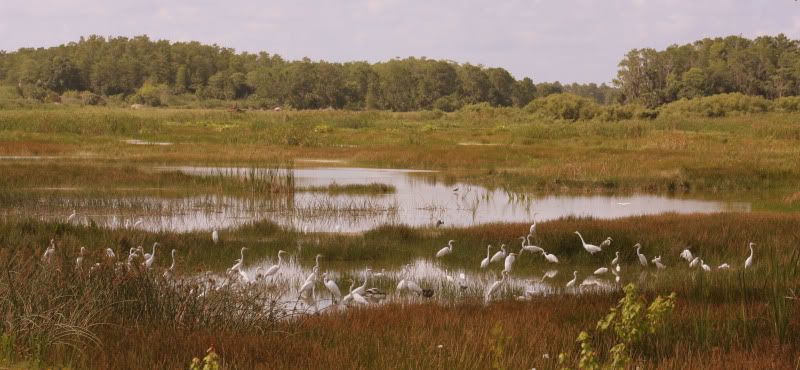


Finding food is also easier with many eyes looking. Once located, the buffet commences. Here a flock of Great White Egrets, Snowy Egrets and a few White Ibis have found a high concentration of fish and frog eggs to feast on.

Around the outskirts of the buffet are Little Blue Herons who are exhibiting commensalism. As the Egrets and Ibis stir things up, the Little Blue Herons feed on what the rest of the birds are not interested in. Essentially commensalism is when one species feeds among others and benefits without harming or benefiting the main species. In this case the Little Blue Heron is the guy that came to the party with the friend you invited. Little Blues are twice as successful when feeding commensally as opposed to individually.

May marked the end of the dry season in Florida which generally runs from December through May 15th. As the wetlands begin to fill with water and prey species re-colonize the marshes and swamps, many of the wading birds will rely less on communal feeding and venture out to forage solo. After a long day of hunting, it’s back to the communal roost for an evening of preening and sleep. Party on.

Sunday, June 26, 2011

Murder in the Marsh - The Florida Sandhill Crane

“Someone just shot a Sandhill Crane in the marsh” I said with disgust. “Is that bad” a friend asked.

Yes that’s bad.

A)    The Florida Sandhill Crane (Grus canadensis pratensis), is listed as Endangered in Florida due to habitat loss and over hunting.
B)    Hunting of Sandhill Cranes is no longer permitted in Florida.
C)    The marsh where it was shot is off limits to hunting.
D)    The marsh where it was shot is within 300 yards of an elementary school
E)     I had just been riding my bike within the range of the shooter.

While a third of the Sandhill Crane population breeds in Canada and Alaska, the Florida subspecies is non-migratory and adults are rearing chicks right now. The marsh I visited has no less than four pairs of adult Sandhill Cranes. Presently at least two of those pairs have several week old chicks. Adults form long-term pair bonds and tend to their young for up to ten months. The marsh is ideal in that the cranes create a nest of debris and vegetation surrounded by water. They feed on insects, small vertebrates, like frogs and snakes and even they also eat seeds and fruits.

The marsh is a manmade stormwater filtration wetland but considering Sandhills lost most of their wetland habitat to drainage and suffered a subsequent population decline, they’ll take what they can get. What they don’t need is a random knuckle dragger using protected birds for target practice.

As my brother-in-law and I made our way towards the exit of the marsh trail, a shot rang out ahead of us. And another. The shooter turned, with rifle drawn on us, turned back to the Sandhill and fired. The bird went down with a wing flapping. Ibis, Anhingas, Herons and Sandhills joined a frenzy of squawks as they ascended and descended on the injured bird. I expected them to fly away but they were as traumatized as we were and seemed to be rallying around the wounded bird. One final shot and the adult bird was gone.

We raced home and called the sheriff, who was dispatched immediately. The shooter left before he arrived, but the single parent, mother of two Sandhill Crane fledglings remained.