
In 2008 the USGS released a potential range map for Burmese Pythons (Python molurus bivittatus) in the United States
As evidence, in 2000 the Everglades National Park Florida

The snakes are a huge problem. Necropsies have found the endangered
Florida Woodrat (Neotoma floridana), Big Cypress Fox
Squirrel (Sciurus niger avicinnia), Wood Storks (Mycteria americana ), Everglades Mink (Mustela
vison evergladensis) and recently a 76 pound deer in the belly of the
snakes.
Compounding the problem is the protective nature and
prodigious offspring output of a female Python. One female can lay up to ninety
eggs. Cold will keep them from spreading north. Strict laws are being put in
place to ban the importation of the largest and most dangerous of the invaders
and most of the locals are intent on dispatching them.
If only I could enlighten the media a little.
1) Alligators
rule the Everglades
2) A
handful of pet Anacondas have been found and they are not known to be breeding
in the Everglades .
3) The
Everglades is over four million acres. The
study of mammal population declines occurred in the Everglades National Park Everglades clean”.
4) The
media has a stranglehold on their readers. We have a right to well researched,
well written information. Not sensationalism.
To those that would release invasive snakes into the Everglades and to those in the media who perpetuate the
python myths – Stop it.




 During the breeding season, many birds develop special plumes or bright colorations to attract a mate (the teal blue eye of the Anhinga, the crimson legs of the White Ibis). The Great Egret has spectacular tail feathers called aigrettes that were once prized by plumage hunters. They appear wispy and delicate and have a yellowed - burnt marshmallow appearance towards there tips.
  In the late 19th and early part of the 20th century, plumage hunters sought out rookeries where they would slaughter nesting birds and take their feathers. Chicks were left to starve. Eggs left unincubated never hatched. The feathers were used for decoration and specifically for women's hats that were all the rage at the time. In 1908 - an ounce of plumes was worth more than an ounce of gold.
  Great Blue Herons, Flamingos, Roseate Spoonbills, Wood Storks, Egrets and other bird populations were severely impacted by this less than noble trade.
 When the plume rage was exposed as murderous fashion, the rage of the nation led to federal legislation banning the sale of plumes. Populations have been slow to rebound over the many decades that have passed and some say for every Great Egret you see today - you might have seen 10 a century ago.
  Here at the rookery, Wood Stork nests far outnumber Great Egret nests. Nevertheless, courtship continues as Egrets flash their aigrettes like a Peacock (since the courtship period is over - I don't have a shot of this). Mates are wooed. Eggs are laid. Chicks are born.
  Here -one of several chicks pesters an adult for partially digested fish.
 We can be thankfull in large part to the
 There are an estimated 10,000 nesting pairs of endangered Wood Storks in all of Florida with at least 50 nests on this tiny mangrove island. Presumably raccoons and other nest predators can not swim out this far, making this an ideal location for not only Wood Storks, but Great Egrets, Snowy Egrets, Anhingas, Great Blue Herons and Black-crowned Night Herons (more on them later).
 Standing nearly 4 feet tall with a wingspan over 5 feet, this huge wading bird uses its massive beak to probe for fish, crustaceans, insects and even baby gators in the shallow waters in and around the Everglades and other Florida wetlands.
  When the water levels are right - Wood Storks nest, but during droughts when water is absent and little prey is available they will not nest or abandon nests if they can't collect 400+ lbs of fish for themselves and their young during the nesting season. (I have yet to see the scales they use to weigh their food...) If the water level is too high and prey species can easily disperse - feeding is again complicated and nesting may not occur.
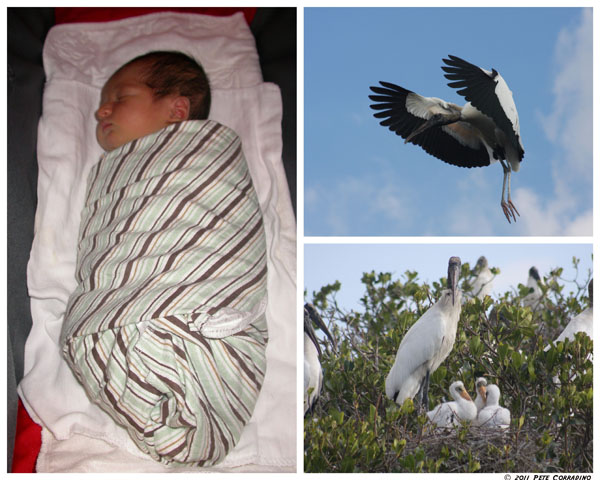
  Their bald heads and long beaks may not win them any bird beauty pageants but in flight they are gorgeous.
  I'm using a Canon 40D with a 300mm zoom which allows me to see details that I hadn't noticed before. Check out the peach-colored band on the underside of the wing feathers. I had thought in the past it was simply sunlight coming through the wing. Not so!


 The nests are made of twigs and branches. They lay 3-4 eggs which hatch in about a month. They fledge (leave the nest) in about 2 months. The drought and human manipulation of the water cycle here in Florida has caused some of the Wood Stork populations to shift breeding to earlier in the season when food is plentiful.
  Birds at the Corkscrew Swamp were nesting in November while these birds should wrap up nesting in a few weeks. Based on birds flying in from the Northeast - we think they are foraging in the Babcock Wilderness Area a few miles away.
  While Wood Storks may bring ugly human babies to unsuspecting parents, there is no doubt that their downy white babies are quite adorable.
  Give them a few months. They'll be bald and goofy looking too.
 I went hiking after work in the Estero Aquatic Preserve and was walking while fiddling with my GPS when I heard a HHHSSSSSTTT - so I screamed like a girl. I was alone. I don't need to admit this, but my honesty has been called into question (I did yell at the pig - the macaw did call me a cracker. 99% of what I relay here is the truth) but for the sake of candor I offer all details here now. I screamed like a girl. It surprised me. It surprised the massive Gopher Tortoise who thought better of his simple hiss and hold your ground strategy and he pulled himself inside his shell.

 They love to dig 5-10 foot deep burrows in the ground where they spend much of their time.


 On my way out of the preserve today - I spooked a Marsh Rabbit who bolted into the palmettos. I didn't scream.