Showing posts with label Harns Marsh. Show all posts

Thursday, September 29, 2011

Babies vs Alligators


I am often asked if I worry about alligators. As a hiker and an Everglades tour guide I see them often. In fact we guarantee guests that they will see them on our tour. I never take for granted that we have massive reptilians that can grow more than fourteen feet in length. I understand them and I respect them. I do not worry about them.

Recently my wife and I took our baby for a stroll on a trail next to a marsh near our home. As she pushed the stroller through a muddy portion of the trail I noticed the stroller tracks bisecting an animal’s tracks. There was no mistaking it. A large all­igator had recently crawled from the river, climbed the muddy berm and descended into the pond on the other side. The large webbed feet made deep impressions in the mud and the sinuous trail of its heavy tail drew a perfect impression of an animal walking with a side to side gait.

The alligator was nowhere in sight, nor was it lurking in wait to snatch our baby. It was a hot day and no doubt it simply wanted to get from one body of water to another. Fish, birds, turtles and other prey that are easily chomped and swallowed are typically on the menu. American Alligators (Alligator mississippiensis) often take to the water at the sight of a person and while attacks do happen, there have been only 568 reported in Florida since 1948. Males were involved in 86% of attacks and unsurprisingly, many of those were provoked.

Feeding an alligator often results in an alligator losing its natural fear of people and they are more likely to approach. Swimming in rivers, canals and ponds, especially at night can mimic the sound of injured prey which draws the attention of an alligator. Water hazards on golf courses can be literal hazards as well.  

Having said all of that, the number of fatalities caused by alligators since 1948 is twenty three. The number of babies in strollers chased by alligators? Zero. Am I careful? Yes. Am I worried? There are more important things to worry about.

Tuesday, June 28, 2011

Buffet Mixer


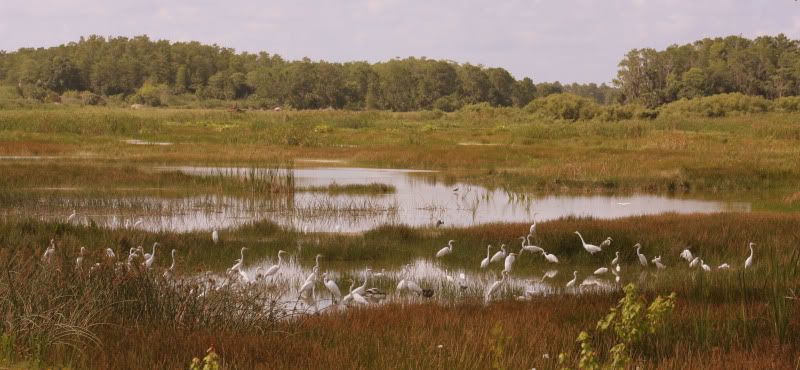
There are a variety of benefits to doing things in groups. Consider the last cookout you attended. Someone else bought the food. Someone else cooked and cleaned up. There was less risk of being eaten by a predator. Communal roosting makes sense too. Eating and roosting together makes sense for Great Egrets, Snowy Egrets and White Ibis.

More ears and eyes means predators are at a disadvantage during a sneak attack. While roosting, huddling can conserve warmth for those with the best spots in the roost. The downside is when you head out for breakfast in the morning everyone follows. The older and experienced birds tolerate social parasitism in exchange for safety in numbers. There is a pecking order and bigger birds can dominate others in the flock.


Finding food is also easier with many eyes looking. Once located, the buffet commences. Here a flock of Great White Egrets, Snowy Egrets and a few White Ibis have found a high concentration of fish and frog eggs to feast on.

Around the outskirts of the buffet are Little Blue Herons who are exhibiting commensalism. As the Egrets and Ibis stir things up, the Little Blue Herons feed on what the rest of the birds are not interested in. Essentially commensalism is when one species feeds among others and benefits without harming or benefiting the main species. In this case the Little Blue Heron is the guy that came to the party with the friend you invited. Little Blues are twice as successful when feeding commensally as opposed to individually.

May marked the end of the dry season in Florida which generally runs from December through May 15th. As the wetlands begin to fill with water and prey species re-colonize the marshes and swamps, many of the wading birds will rely less on communal feeding and venture out to forage solo. After a long day of hunting, it’s back to the communal roost for an evening of preening and sleep. Party on.