Showing posts with label Little Blue Heron. Show all posts

Saturday, November 12, 2011

Formerly Known As the Louisiana Heron


I have a book called “American Wildlife Illustrated” from 1940 that sits on my book shelf with all of my other aging natural history references. Some of the books are as new as 2010 but for every day that goes by there is a fact, a theory or a matter of taxonomic nomenclature that becomes wrong, disproved or obsolete. Printed material is old school. Your digital Audubon Guides can be updated when needed.

When I started guiding in the Everglades in the 90’s there was a bird that everyone in the swamps called the Louisiana Heron. I was told it was also called a Tricolored Heron (Egretta tricolor), but people can be stubborn and despite the bird carrying a name of another state, the locals were content to keep the traditional name. I took a few years off from guiding and returned again in 2007. When I pointed to a heron and called it a Louisiana Heron you would have thought I called a Badger a Buffalo. “It’s a Tricolored Heron. Ain’t no one calls it Louisiana Heron no more.” Ok then. Tricolored it is.

To be fair the name change had been approved by the American Ornithologist’s Union in 1983 so everyone had ample time to acclimate to the new colorful name. Why the change? Eliminating local geographic names was deemed more appropriate. After all, the “Louisiana Heron” is found from the eastern seaboard of the United States, south through Texas and in a few spots in Central and South America. The three colors of the Tricolored Heron include a white belly, a powdery blue body and a reddish patch on the back.    

They are occasionally confused with the much larger Great Blue Heron (Ardea herodias) and the similarly sized Little Blue Heron (Egretta caerulea). What always stands out to me is the white crest of feathers that the Tricolored adults develop during the breeding season. It pops out a bit in the back and looks like a mullet hairstyle.

There are still some old school birders who prefer “Louisiana Heron” but Tricolored Heron is certainly the norm. What you won’t see or hear anywhere  is someone petitioning for a name change to “Mullet Crested Heron”. 

Friday, May 7, 2010

Reflections - The Little Blue Heron

I never realize how different I look today compared to 20 years ago until kids see pictures of me from way back when. “You used to have hair?” is often the brilliant observation, as if I was bald from the day I was born. Yes we change. In some cases drastically and others quite subtly but when you look in the mirror it’s still you that peers back.
I imagine Little Blue Heron (Egretta caerulea) chicks having the same conversation with their parents. “You mean you weren’t always blue?” Of course this doesn’t happen. Herons could care less about these things, but if they did recognize their reflection as a fledgling compared to an adult, the bird looking back would look entirely different.
Adult birds have attractive blue-grey plumage with purple feathers around the head. While other birds develop breeding plumage for courtship, the Little Blue Heron’s coloration serves as a built in chick magnet. So to speak.
I see them foraging alone while other wading birds such as Snowy Egrets (Egretta thula), Great Egrets (Ardea alba) and White Ibis (Eudocimus albus) feed in the shallows together. These three species of white-plumed birds benefit from feeding together. Additional eyes allow for better protection from predators on land, in the sky and in the water. While ibis probe the mud for insects and crustaceans, egrets feed on the fish and other critters stirred up by the ibis.
An adult Little Blue Heron would look completely out of place in a flock of white birds. But the observant birder might notice a white bird among the flock that looks slightly different. For the first year or two, the juvenile Little Blue Heron is decked out in nearly colorless feathers. They feed and roost among other white birds and when they have the life experience to survive on their own, they molt and develop the colorful blue and purple costume.
I spotted this Little Blue Heron hunting alone. Its eyes surveyed the surface of the water for minnows or insects, but my mind considered the idea that the heron was looking at its reflection and wondering what it will look like when it grows up.

Monday, February 23, 2009

Backyard Bird Count - Green Cay Oasis

Invariably during each Everglades tour I remind people that "this area used to be wetland". From Fort Myers to Naples to Miami to West Palm Beach, nearly half of the Everglades has been "reclaimed".

While the niece and nephew were in town, my sister Tiffany and I took them to an area of Boynton Beach called Green Cay Wetland which seems to be the last remaining oasis in Palm Beach County that hasn't been developed (although it is a "constructed wetland"). It also happened to be during the Great Backyard Birdcount - so here's my unofficial tally.
Green-backed Heron

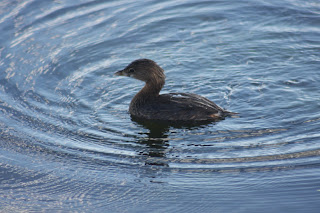
Pied-billed Grebe

Glossy Ibis

American Coot (look at those crazy toes!)

Limpkin

Mottled Duck


Common Moorhen

Little Blue Heron

Blue-winged Teal

Purple Gallinule

And an Alligator in the Duckweed