Friday, June 24, 2011

Sand Trapped - The Big Cypress Fox Squirrel

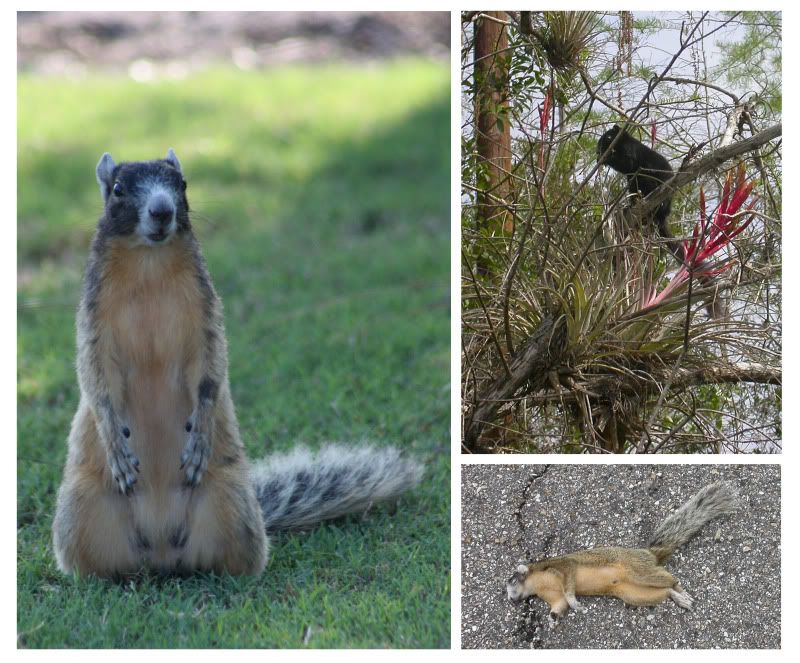
People don’t appreciate squirrels. One person’s pest is another person’s treasure. Such was the case as I drove past a golf course on my way out of a gated community in Fort Myers. Bounding across the fairway was a large Big Cypress Fox Squirrel (BCFS). I slammed on the brakes and jumped out, camera in hand. The tan-bellied, salt-and-pepper backed squirrel was as interested in me as I was of it and we stood for a moment like two gunslingers, unflinching. A disgusted woman shook her head and headed after her ball.

The Big Cypress Fox Squirrel (Sciurus nigra avicennia), is an endemic subspecies here in southwest Florida. They’re found from the Caloosahatchee south through the mangroves along the Gulf of Mexico. Unlike most of Florida’s terrestrial mammals, the BCFS are diurnal (day active), ground foragers. They feed on pine and cypress cones, palmetto berries, bromeliad seeds and a host of other native seeds and fruits. They prefer an open understory in the pine flatwoods, cypress swamps and mangroves. What is unusual is that as development continues to slice up their habitat, leaving it more and more fragmented, the squirrels have taken to golf courses which retain characteristics of their preferred habitat – open grazing areas with forested refuges.
Golf course BCFS have been shown to be more gregarious. They mate year round and are less susceptible to food shortages. Land managers have helped protect the species by leaving natural vegetation and planting trees, shrubs and grasses around the golf courses that specifically benefit the BCFS. The problem is sustainability. Increasingly these squirrel-occupied urban islands become more separated from natural communities and any link to other populations requires hazardous and often fatal road crossings.

Additionally, foraging around a golf course may seem like the life of leisure but without the protection of a forest canopy the squirrels must keep an eye skyward for birds of prey.

Their relaxed social standards could put them at risk as well. Normally solitary, golf course squirrels that congregate are at greater risk of spreading diseases to one another like Squirrel Poxvirus. A BCFS was found to be infected in 2010 and although an outbreak has not been reported, the virus is spread by contact and would have the greatest impact on sociable squirrels.

Golf courses have benefited BCFS to a degree but ultimately these populations must remain connected to their backwoods neighbors or they are all doomed. Will anyone miss them when they’re gone? 

Friday, June 10, 2011

Distracted–the Polyphemus Moth


I’ll be honest. I was just playing Angry Birds, the horribly addictive app I can play on my iPhone. It’s right next to Audubon Nature Florida. I’m supposed to be writing about a moth. I had intended to simply look up the scientific name for the moth in question on the Audubon app. No I don’t know all of the scientific names of every plant and animal. Gorilla is easy. But in doing that quick bit of research my attention was drawn to the small square box on my shiny smartphone housing an angry cardinal. The next think I know I’m launching ferocious birds at pigs. I’m ashamed.

The Polyphemus Moth (Antheraea polyphemus) lives and dies by behavior such as mine. The massive, night-flying member of the Saturniidae family of moths is decorated to both blend in among the leaf litter and confuse would-be predators with flashy eye spots. The six-inch wide, heavy-bodied moth has a week to live as an adult. There’s no time to feed. Females cast off an enticing pheromone that the males pick up on with their large, feather-like antennae. The males mate with multiple females while the females mate and go about finding a safe spot to lay their eggs.
At rest the tan, scalloped wing margins look like leaves and the insect can simply camouflage with its surroundings. At risk of being preyed upon, the Polyphemus Moth can flash the hind wings, unveiling two massive eye-like spots that give the appearance of something looking back. The wings are folded back in. The eye spots disappear and a confused predator either weighs the possibility of a challenge from another predator or can no longer find the thing with the bright flashy colorful spots that it wanted to eat.
Those familiar with Greek mythology might recognize Polyphemus as the one-eyed son of Poseidon and thus the naming of this beauty of a moth, which got me wondering why they named the movie the Poseidon Adventure. Back to the internet and long story short, Ernest Borgnine is still alive. Ugh. Now I need to research why the Angry Birds don’t have wings.